



Let’s stop pretending.
For years, we’ve been told that recycling is the solution to fashion’s waste problem. Put your clothes in a bin. Let brands set recycling targets. Roll out EPR schemes. Job done.
Except… it’s not true. And deep down, the industry knows it.
The uncomfortable truth: textile recycling is fundamentally flawed
Despite all the marketing, less than 1% of post-consumer textiles are recycled back into new clothing. Not because people don’t “recycle properly”, but because the system itself doesn’t work at scale.
Most garments:
- Are made from blended fibres that are technically or economically impossible to separate
- Lose fibre quality every time they’re mechanically recycled.
- Require energy-intensive, chemical-heavy processes for chemical recycling (which is still largely pilot-stage, expensive, and limited in capacity – and according to recent research, recycled polyester shed 50% more micro-plastics than virgin polyester.
What we call “recycling” today is mostly:
- Down-cycling (insulation, rags, stuffing)
- Incineration with energy recovery
- Or exporting waste to another country and calling it “circular” 🙄
That’s NOT circularity. That’s delay!
Circular is a COMPLETE circle. No beginning, no end. Yes, I know it is idealistic but you know what i mean …..
Recycling survives, and dare I say thrives (the companies, not the output) because it protects the status quo
Here’s the part NO ONE wants to say out loud:
Recycling is popular because it DOESN’T fundamentally challenge overproduction – it in fact aids it.
It allows brands to:
- Keep producing at scale
- Keep selling high volumes
- Keep linear business models intact … while shifting responsibility to consumers at end-of-life.
“Don’t worry — it’s recyclable” has become the moral permission slip for business as usual. (This kind of messaging has been proven to actually promote further consumption … not reduce it.)
Meanwhile, reuse and upcycling quietly outperform recycling
Every credible life-cycle assessment shows the same hierarchy: Reuse > Repair > Upcycling > THEN Recycling
Why? Because the biggest environmental impact of a garment is making it in the first place. Making a garment from scratch vs. Up-cycling a garment creates 70X more negative impact in terms of pollution, energy, water use etc. (Ps. If you want data sources, let me know, I’ll dig them out for you)
Upcycling:
- Preserves the original material value
- Avoids fibre reprocessing entirely
- Can reduce carbon, water and energy impacts far more than recycling per garment
- Extends product life without requiring virgin inputs
And yet… up-cycling barely features in policy discussions, EPR frameworks, or brand roadmaps. I actively look for it in articles and reports ALL THE TIME … but it rarely gets a noticeable mention.
Why?
Because upcycling threatens scale — not impact
Let’s be honest.
Upcycling is ignored NOT because it’s ineffective, but because it’s perceived as:
- Too labour-intensive
- Too local
- Too “messy”
- Too difficult to standardise at global scale
In other words: It doesn’t fit the industrial growth model the fashion (bosses) is built on.
If it can’t be standardised, it also can’t be controlled and systemised … a bit like home-schoolers, with their own study plans and agendas. They will always remain “the outsiders”, no matter how brilliantly they perform.
Recycling promises future technological scalability – costly, but apparently worth every penny.
Upcycling demands systemic change NOW – and that’s the real issue.
It’s an inconvenience for scalability.
Circular fashion is NOT a technology problem. It’s a business model problem.
Yes, tech can help alleviate the problem but NOT solve it, if the business model doesn’t change.
Upcycling works. Reuse works. Repair works.
What doesn’t work is trying to solve a volume problem with temporary end-of-life solutions.
If we were serious about impact, we would:
- Incentivise reuse and upcycling FIRST in EPR schemes – I remain hopeful that thsi will happen.
- Fund local remake, repair and rework infrastructure
- Design garments for disassembly and redesign (Yes, even in fast fashion!)
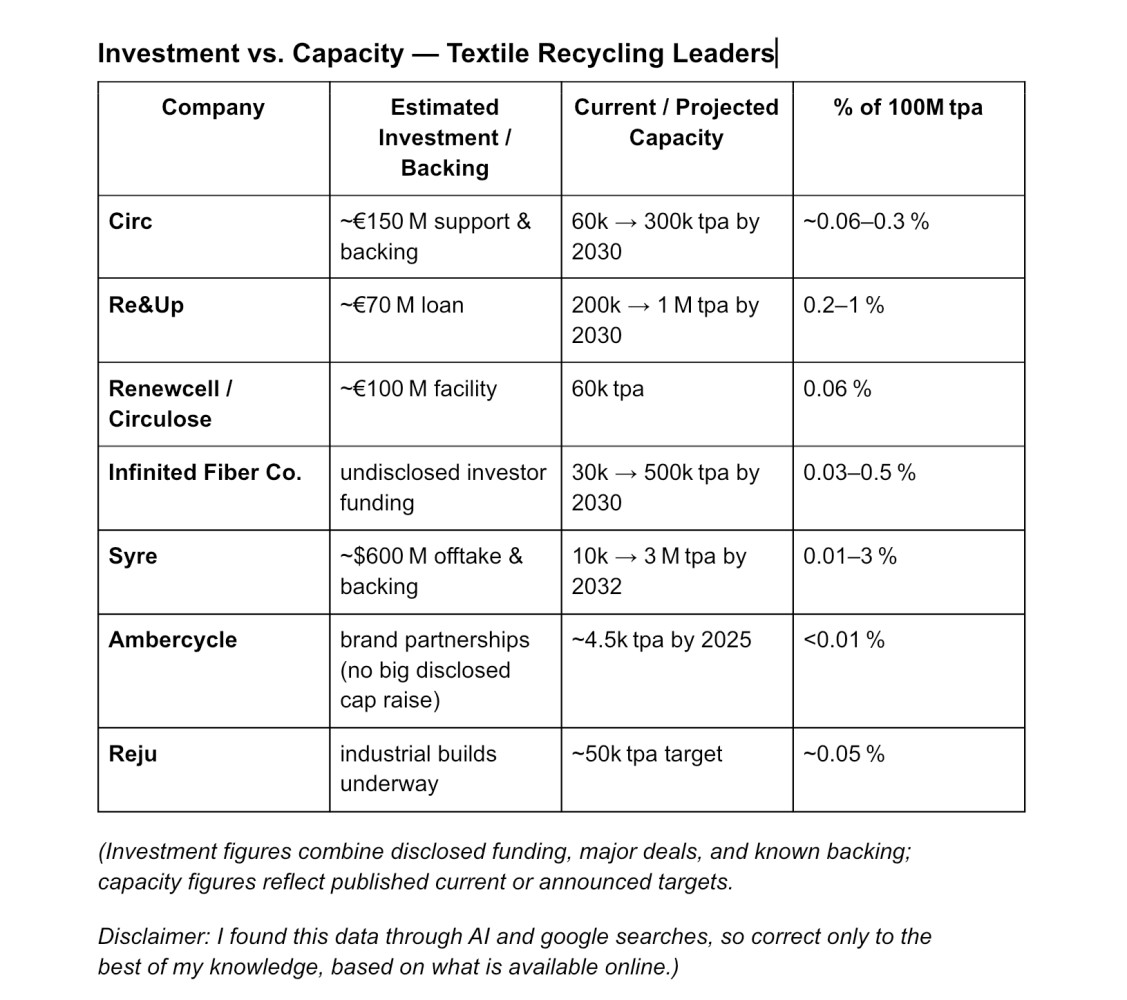
- Stop using “recyclable” as a moral shield for overproduction – if you look carefully at who is investing the most in recycling projects, you will notice it is also those who produce the most ie.the ones who created the problems in the first place. 🤔
- Measure success in new production avoided, not waste processed
Recycling HAS a role. Of course.
But we can NEVER recycle our way out of this problem if over-production continues. It is not possible. Of course, this is just my own personal opinion. You may think otherwise.
In the meanwhile, I will continue to support reuse, repair and up-cycling brands and initiatives, both personally and professionally – at least there, I know where I stand and even if I am not making a huge impact within the industry, I am making a contribution to someone who care’s livelihood.
And if I come across as bitter and angry … well, I am not, I am just passionate. 😝
I also understand that there is no “perfect” solution in the industry and it will ALWAYS make more of a negative impact than good – unless we all stop wearing clothes.
I’ll end this longer-than-planned article here with the advice that Johan Graffner (Founder of Dedicated) shared in recent interview: “Base your decision-making on net-impact and focus on areas where you can make the most positive impact”.
A bit about me.
I am the founder of We Disrupt Agency, a circular strategist helping the fashion industry become “better”, through consulting, collaborations and implementation of circular solutions.
I have, after almost 20 years of being in and out of the fashion industry, a love-hate relationship with it. I hate the “destructive” nature of the industry but yet I love it because of the same. I thrive in problem-solving and stayed passionate for almost as long as I have been in the industry to find a solution to this never-ending problem of over-production, over-consumption and textile waste issue.
I have written a book called Making Sense of Fashion to help consumers understand what they can do make the industry more sustainable.
Currently writing a book called Fashion’s New Blueprint to help fashion entrepreneurs implement circular business model and thinking in their businesses. (Launching January 2026)
I often interview change makers in the industry for Lead With Purpose Podcast and regularly speak at schools and universities to help guide the next generation of leaders in making more conscious decisions for their future.
In summary, I am just a person who wants to do what is right for the planet and those who inhabit it.
I am always open to hear about new projects that share the same sentiments, so please do feel free to get in touch if you’d like to discuss a collaboration or partnership with us – hello (at) wedisruptagency.com.


Comments +