



Earlier today, my co-founder Dinie van den heuvel at Circular Fashion 360, sent me a post about Circ® (via The Earthshot Prize ) who secured a €150M investment in 2023 – and I felt somewhat “annoyed” and started going down the rabbit hole of finding out more about the recycling industry ie. investments vs. Impact – I am not normally a numbers person but what I found was pretty “enlightening”, so thought I’d share some of it with you and get your view on this. (Btw, before we go any further, congratulations Circ. You guys are doing amazing work. This is more an exploration of the system itself, rather than individual companies)
Every year, the fashion industry produces over 100 million tonnes of textile waste. Landfills and incinerators swallow most of it – up to 90% according to some reports. The narrative we hear is hopeful: “Technology will save us.” Innovative companies are developing chemical recycling, fibre separation, and advanced textile processing — and yes, these breakthroughs are all very exciting.
This is the question that was triggered in me, after seeing the post shared by Dinie: Are the investments we’re making ACTUALLY proportional to the scale of the problem? Or not?
Let’s look at some numbers — investment, capacity, and the true scale of textile waste:
– approx. 92–120 million tonnes of textile waste generated annually worldwide. Less than 1 % is currently recycled back into new clothes.
– Global textile recycling industry value is forecast to grow from ~USD 8.4 billion in 2025 to nearly USD 12 billion by 2030.
We have an industry worth BILLIONS of dollars here … an industry based on solving a huge planetary issue. Amazing. So let’s get into more details
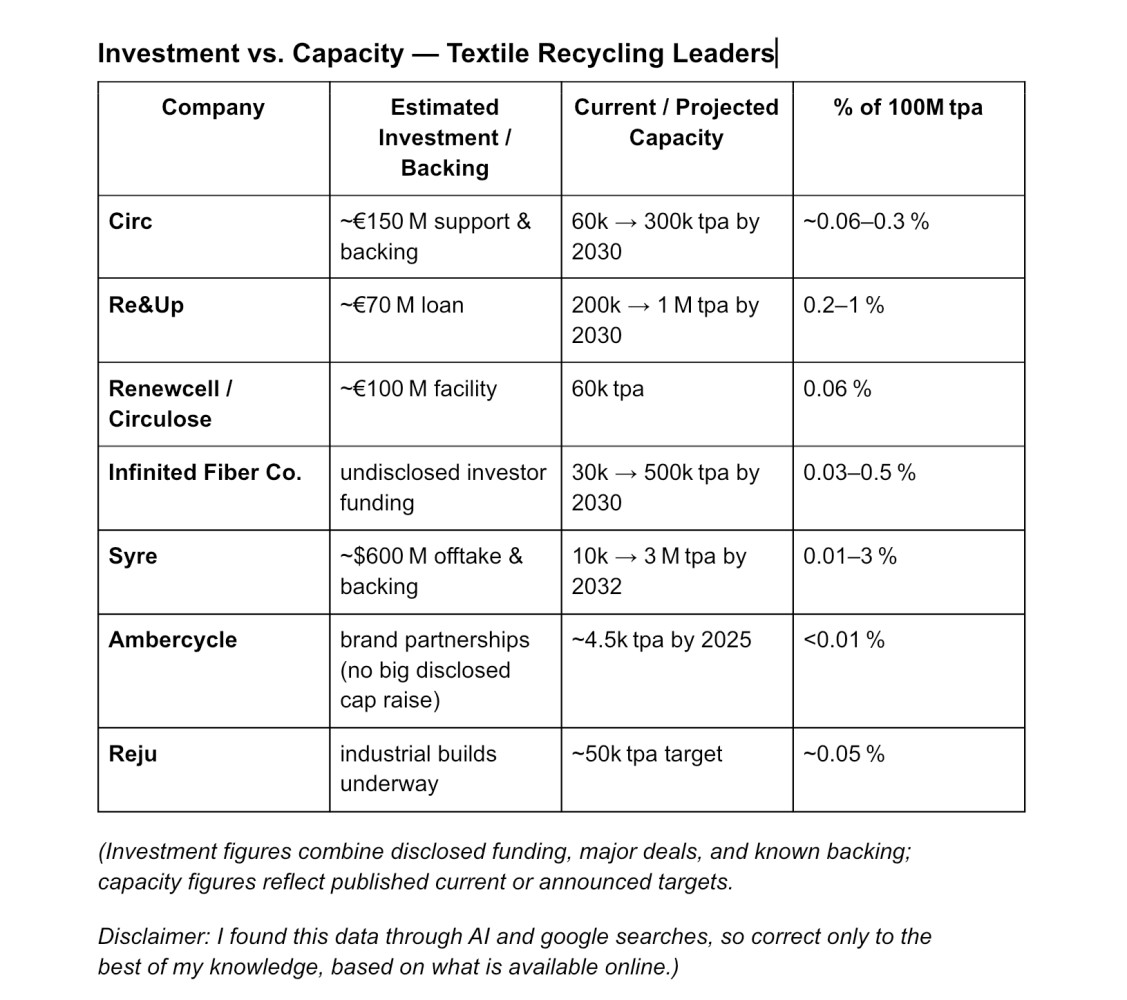
So, if we look at the figures shared, we can see that just about USD 1 billion + 3 undisclosed amounts has been invested so far. So let’s assume it is around USD 1.5 billion total. The total capacity for this investment should, if the figures are correct, is between 0.42-2.22% of total textile waste volume. What? Is that all? It doesn’t make sense, does it?
If “they”, the industry, and the investors actually believe this will work, why don’t they invest MORE in recycling? Why are they only investing such small amounts? I thought recycling was going to solve the issue … or isn’t it? Why didn’t they invest more than only USD 150 million in such a great as solution as Circ?
Based on above numbers, we need to invest a total of USD 67 billion to recycle 100% of this waste (I know its not possible because not everything is recyclable – just hypothetically speaking)
What This Really Reveals
Recycling technology is essential — but realistically, we are not going to find USD 67 billion anytime soon for this. Besides recycling is only one piece of the puzzle. What about the rest?
And this is what annoys me.
Investments are heavily skewed toward headline tech, despite the low impact figures, leaving upstream solutions underfunded, which gets very little funding in comparison to recycling:
- Design for longevity
- Upcycing & reuse
- Material transparency
- Repair & durability
- Producer responsibility frameworks
Without systemic investment in the full circular ecosystem, recycling risks becoming (and is) a bandaid on an industrial-scale problem with an insatiable appetite for funding.
Investing millions in recycling tech is impressive — but if we want real circularity, we MUST invest same or more upstream. Yes or no?
Recycling will never close the loop alone – in fact, all it does is, enabling brands and manufacturers to keep producing more because it requires constant feeding of a large amount of waste to keep the system running. Without waste, there is no recycling industry. So we must create more waste ….
Recycling MUST be paired with design, reuse, upcycling, repair, and transparency — the areas that ACTUALLY reduce the need for recycling in the first place, otherwise it is not really a solution for full circularity.
The question is:
If €150 million for one company yields <0.3 % of global textile waste capacity, and even ambitious industry forecasts hit only single-digit percentages, then, are we funding the right solutions — or just celebrating tech while ignoring systemic change?
These numbers just don’t add up for me. What am I missing?
I’d love to hear perspectives from circular economists, recyclers, designers, investors, and policymakers. Like I said earlier, I am not really a numbers person but these numbers just don’t stack for me. What am I missing?
If we were to spend another €10-25 billion to solve the textile waste issue, where do you think we should we invest it?
Sources: AFRY H&M Foundation World Textile Newswire
We at We Disrupt Agency work with organisations who believe in building FULL circular eco-systems that add value to both people, planet AND profit. Get in touch if you want to discuss your company’s circular strategy with our team. Hello(at)wedisruptagency.com or via our contact form.


Comments +